
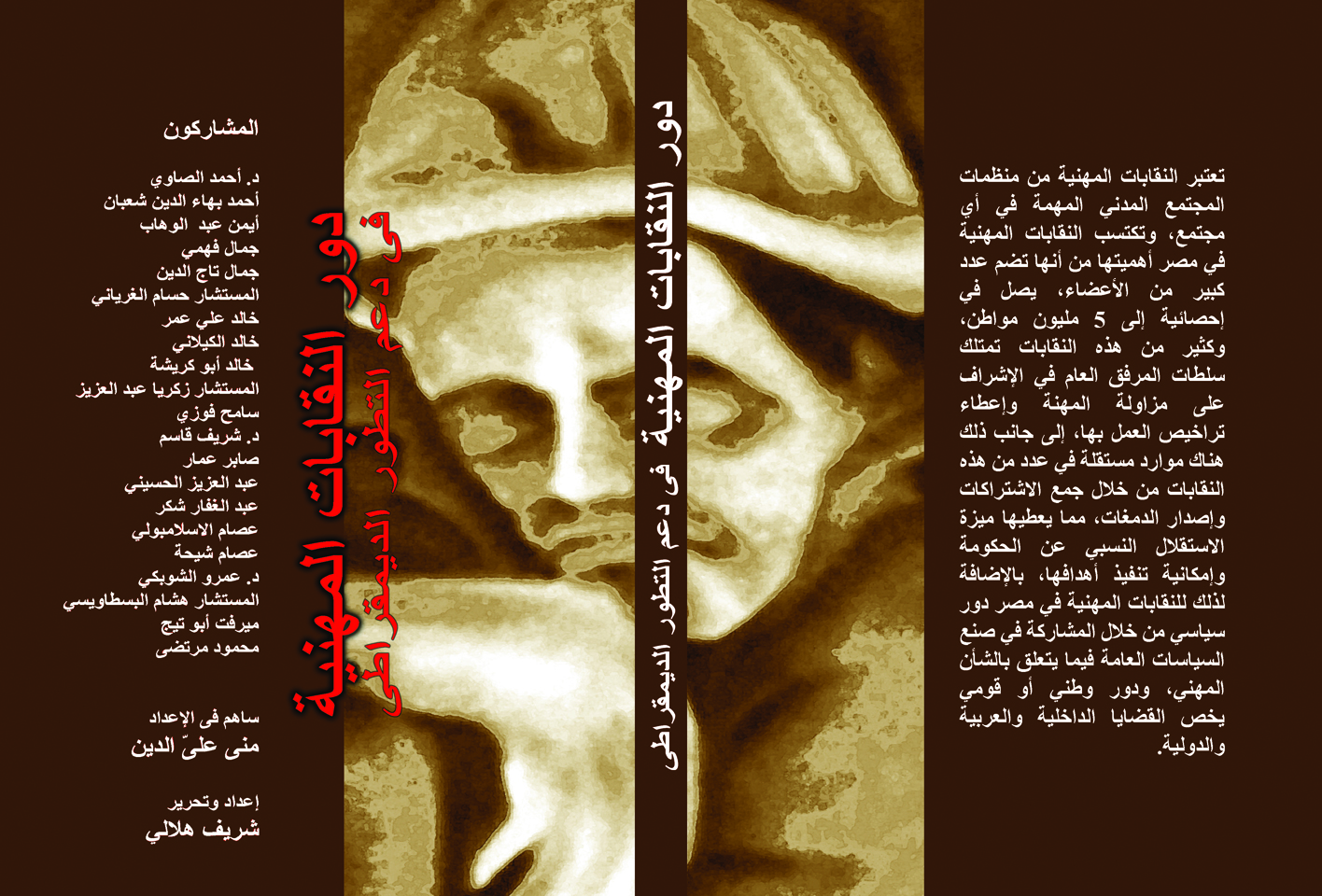
This book includes a number of research papers, interventions and opinions of researchers and prominent members of several professional syndicate boards and Egyptian professional syndicate activists, in addition to a number of human rights activists and parliamentarians.
It also addresses a number of issues raised according to a specific methodology, and discusses them with a large audience of union members, professional association council members, and activists.
Among the issues raised in these seminars and workshops are:
– The role of professional associations in supporting democratic development
– The performance of professional associations between the political and professional spheres
The Role of Political Parties and Forces within Professional Syndicates
– Coordination and Networking among Professional Syndicates on Various Issues
– Representation of Important Groups within Professional Syndicate Councils, including Women, Youth, and Christians, and How to Activate This Coordination
– Syndicate Pluralism and the Opinion of Professional Syndicate Leaders on This Issue
The negative effects of the laws governing professional associations, primarily Law 100 of 1993 and its amendments.
– The relationship between the state and professional associations and its reflection in the actions of each party.
– The role of associations in training young professionals, both in professional traditions and democratic principles.
– The issue of judicial independence and an examination of the feasibility of establishing an independent judges’ association.
This book includes papers from several seminars and workshops organized by the Arab Foundation for Supporting Civil Society and Human Rights, as follows:
First: The Role of Professional Syndicates in Supporting Democratic Development. Participants in the seminar included members of the Bar Association, the Journalists Syndicate, the Commercial Syndicate, representatives of the Engineers Against Guardianship group, and members of the Teachers Syndicate. A number of activists and representatives of human rights organizations attended this seminar, which was dedicated to discussing the role of professional unions in supporting democratic development in Egypt.
In the same vein, this book includes workshop papers on the problems of coordination and networking between professional associations, previous experiences in this field, the role of political forces in the success or failure of coordination and their concept of coordination, as well as the role of the state and its agencies in the success or failure of coordination, and an evaluation of previous coordination experiences.
The book includes workshop papers discussing the representation of marginalized groups in professional syndicate councils. Two papers were presented at the symposium, one by Professor Mervat Abu Tig, lawyer and head of the My Mother Association for Rights and Development, and the other by Professor Sameh Fawzi, researcher and journalist. Professor Nabil Abdel Fattah, expert at Al-Ahram Center for Political and Strategic Studies, commented on the two papers.
The book discussed the issue of trade union pluralism through the papers of the workshop organized under the title (Professional Unions between Trade Union Pluralism and Single Organization).
The workshop discussed a number of topics, most notably: the concept of trade union pluralism in labor or professional literature, the advantages and disadvantages of trade union pluralism in professional and labor organizations, and whether there is a possibility of applying the concept of trade union pluralism in professional unions.
The workshop concluded that professionals have the right to draft their own laws and that legal protection must be provided to all those who express their opinions, regardless of their profession.
A final trend did not reject union pluralism in principle, but expressed reservations about its implementation in the current situation.
