
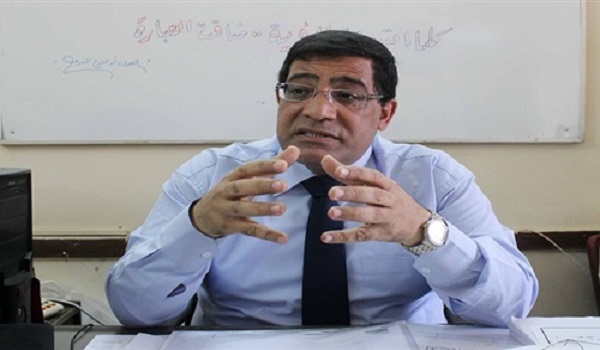
the ruling issued by the Shorouk Misdemeanor Appeals Court on Thursday, December 25, which upheld the imprisonment of economic expert Abdel Khaleq Farouk for a period of five years, rejecting the appeal submitted by him and affirming the verdict in Case No. 4527 of 2025 (Shorouk Misdemeanors), related to Supreme State Security Case No. 4937 of 2024.
Abdel Khaleq Farouk (67 years old) faces charges including “joining a terrorist organization, spreading false news and statements, and misuse of social media,” in connection with his articles and research writings that analyzed the economic policies adopted in the country.
The Arab Foundation affirms that this ruling constitutes a serious violation of freedom of opinion and expression and contradicts constitutional guarantees and international obligations that protect individuals’ right to peacefully express their views, particularly on matters related to public affairs and economic policies.
The Foundation believes that the ruling issued against researcher Abdel Khaleq Farouk, based on his opinions, analyses, and economic research, represents the use of custodial penalties in cases related to freedom of expression. This contradicts fundamental principles of justice, undermines society’s right to knowledge and free public debate, and restricts the critical and oversight role of researchers and intellectuals.
Sherif Helaly, Executive Director of the Foundation, emphasized that the imprisonment of researcher Abdel Khaleq Farouk due to his economic writings constitutes a clear violation of academic freedoms, which are a cornerstone of freedom of scientific research. These freedoms are affirmed by international standards and conventions, which stipulate that critical academic research must not be criminalized or punished as long as it is conducted peacefully and within a professional framework.
The Foundation considers that these charges and the resulting judicial rulings represent a negative and dangerous development in the human rights situation, particularly amid increasing restrictions on public space.
The Foundation notes that this ruling coincides with summonses and investigations targeting a number of writers, intellectuals, and politicians, including Dr. Ammar Ali Hassan and writer Alaa El-Khayam, in addition to the continued detention of hundreds of individuals in cases related to freedom of expression. This reflects a systematic policy aimed at restricting freedom of expression.
These practices violate Egypt’s international obligations under the International Covenant on Civil and Political Rights (ICCPR), which Egypt has ratified, particularly Article 19, which guarantees every person the right to hold opinions without interference and the right to freedom of expression, including the freedom to seek, receive, and impart information and ideas through various means.
The Foundation also affirms that the continued use of detention in opinion-related cases constitutes a breach of the commitments Egypt made during its participation in the Universal Periodic Review (UPR) mechanism before the United Nations Human Rights Council.
At the constitutional level, this ruling contradicts the Egyptian Constitution of 2014, particularly Articles 65 and 71, which guarantee freedom of opinion and prohibit the imposition of custodial penalties for crimes committed through publication or publicity, except in narrowly defined cases.
In this context, the Foundation calls for:
An end to security and judicial prosecutions against researchers, writers, and intellectuals due to their peaceful opinions.
The release of all those detained in cases related to freedom of opinion and expression, as well as those who have exceeded the legally prescribed limits of pretrial detention.
An end to the use of imprisonment as a tool to restrict public space, and the opening of a genuine space for free and responsible discussion of public policies.
Full compliance with the provisions of the Constitution and international standards related to freedom of opinion, expression, and academic freedoms.
